

Kubo Laboratory focuses on two main research areas: metamaterial-based energy harvesting and nonradiative cooling, with particular emphasis on establishing cooling technologies for densely integrated electronic devices in automotive electronics and servers. Our energy harvesting research converts low-level ambient thermal energy into electricity to power IoT and wearable devices. In nonradiative cooling, we combine thermal radiation absorption by metamaterials with heat transport through thermoelectric devices to extract heat from objects while generating electricity. By pursuing thermal management technologies that function even in enclosed spaces, we aim to harness untapped thermal energy and improve the energy efficiency of electronic devices.
Metamaterials are artificial materials engineered to exhibit optical properties unattainable with naturally occurring materials. They offer extraordinary capabilities, such as negative refractive indices and super-resolution beyond the diffraction limit of light.
Metamaterial nonradiative cooling
We are developing a new cooling technology that combines thermal radiation absorption by metamaterials with heat transport through thermoelectric devices.
By extracting heat from objects while generating electricity, we aim to enable thermal management in enclosed spaces.
We are exploring applications in cooling densely integrated electronic devices, including automotive electronics and servers.
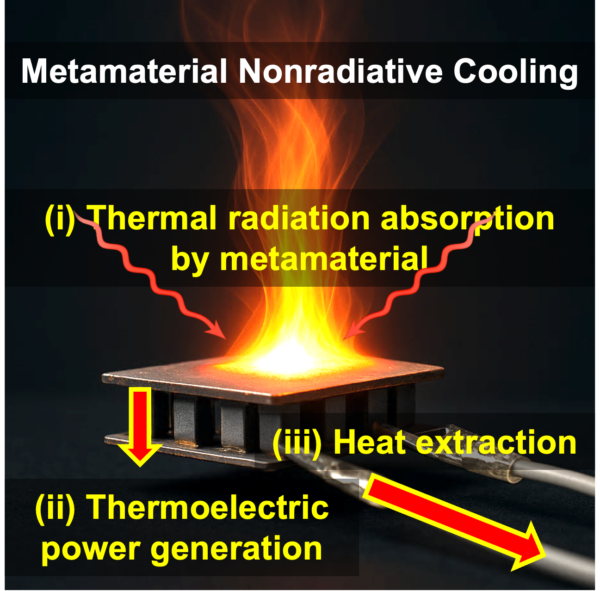
N. Kawamura, T. Tanaka, and W. Kubo*, “Non-radiative cooling”, ACS Photonics, 11, 1221-1227, 2024. [Link]
久保若奈 “密閉空間内を冷却する新技術 メタマテリアル非放射冷却”, 「光学」第54巻第6号, 232, 2025.6.
久保若奈 “メタマテリアル熱電変換と非放射冷却”,『メタマテリアル/メタサーフェス実用展開の可能性~メタレンズ・通信・エネルギー・音響等応用に向けた研究動向~“, 情報機構, 289-297. 2025. 5.
久保若奈 “メタマテリアル熱電変換とその展開”, Optronics, 514 (10), 98-102, 2024.
(Patent) 出願番号2026-033668, 久保若奈,電磁波吸収体、冷却装置、熱電変換装置,東京農工大学
(Patent) 出願番号2023-134713, 特開2025-29848, 久保若奈, 川村直也,冷却装置, 東京農工大学
Metamaterial thermoelectric conversion
We propose a thermoelectric device that can produce a thermal gradient even in a uniform-temperature environment. We introduced a metamaterial absorber (MA), which comprised a transparent calcium fluoride layer sandwiched between a silver mirror layer and silver microdisk arrays, at one end of a thermoelectric device made of bismuth antimony telluride. The heating efficiencies of the MA and opposite electrodes of the device were unbalanced; consequently, the Seebeck effect was induced, resulting in electricity generation. We fabricated the MA on a copper electrode loaded on a thermoelectric device, and the device was placed in a uniform-temperature environment at 364 K. The thermal gradient across the device was experimentally measured and was found to be 0.14 K.

H. Tamehiro, A. Ueno, H. Wang, Md. Abdur Rahman, Joel K.W. Yang, and W. Kubo*, “Optical Wireless Power Transfer by Thermoelectric Device with Thin Film Absorber”, the IEEE Journal on Wireless Power Technologies, 1,0300106-0300106 (2026).
R. Nakyama, S. Sohei, T. Tanaka, and W. Kubo*, “Metasurface absorber enhanced thermoelectric conversion”, arXiv:2308.05956. [Link]
T. Asakura, T. Odaka, R. Nakayama, S. Saito, S. Katsumata, T. Tanaka, and W. Kubo* “Metamaterial Thermoelectric Conversion “, arXiv.[Link]
S. Katsumata, T. Tanaka, and W. Kubo* “Metamaterial perfect absorber for intensifying thermal gradient across thermoelectric device”, Optics Express, 29, 16396-16405, 2021. [Link]
久保若奈 ”均一な熱輻射環境における熱電発電を可能にするメタマテリアル熱電変換” 電気計算 2026年4月号 20-25, 2026.4
久保若奈, “メタマテリアルによる熱電変換”, 応用物理 93 (9), 531, 2024.
Non-Hermitian Photonics
Non-Hermitian optical structures harness the properties of open systems involving optical loss or gain to control light propagation and absorption.
Our laboratory designs and fabricates structures that use asymmetric arrangements of lossy materials to control thin-film interference and electromagnetic field distributions.
We aim to achieve distinctive optical responses, including unidirectional absorption, in which absorptance depends on the direction of incidence.
Through numerical simulations and optical measurements, we investigate the relationships between structure, material properties, and optical response.
We further explore functional materials for controlling absorption and thermal emission, with applications in smart windows and thermal management.
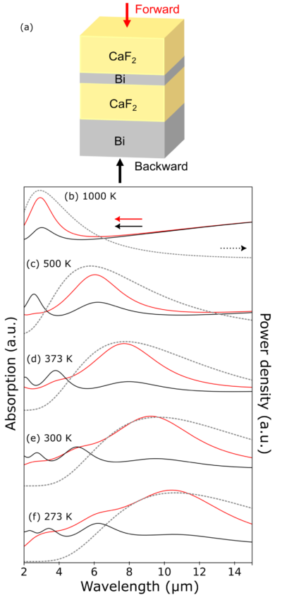
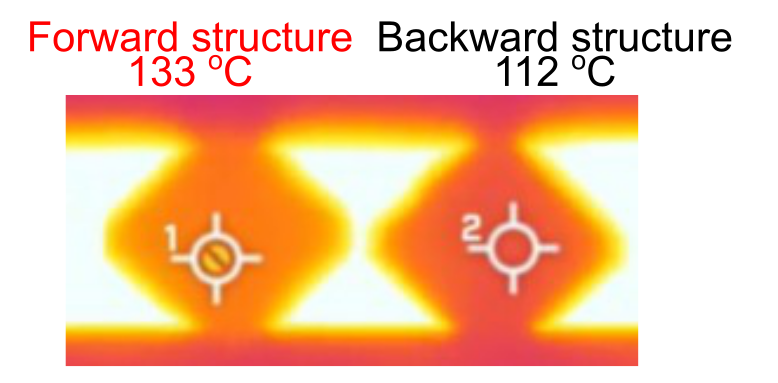
A. Yamamoto, Ganbat Batorgil, Yu-Jung Lu, Satoshi Iwamoto, and W. Kubo*, “Robust Broadband Infrared Unidirectional Absorption Enabled by a Non-Hermitian Multilayer “, arXiv, arXiv:2605.21926. [Link]
A. Yamamoto and W. Kubo*, “Thickness-Engineered Broadband Unidirectional Absorption in CaF₂/C₆₀ Multilayers”, under review.